

‘Total peace’ or ‘all-out war’? Colombian voters face stark choice as rebel attacks surge | Colombia
The landmark 2016 peace deal between the Colombian government and the largest insurgent army in Latin America succeeded in some ways: the Revolutionary Armed Forces of Colombia (Farc) agreed to lay down their weapons, and the violence that had racked the country was substantially reduced.
But the deal alone could not end the decades-long armed conflict for good. Subsequent administrations slow-walked the implementation of the settlement, which was rejected by Farc dissidents and other rebel factions.
When Gustavo Petro, a former member of another rebel faction, became president in 2022, he pledged to achieve “total peace”, signing deals with all of the country’s armed groups, including leftwing rebels and organised crime factions.
Four years on and weeks before the country elects Petro’s successor, guerrilla attacks are surging and Colombians are experiencing a bitter sense of deja vu. Amid a rise in homicides, kidnappings and massacres, the decades-long internal armed conflict that claimed nearly half a million lives is once again central to the vote.
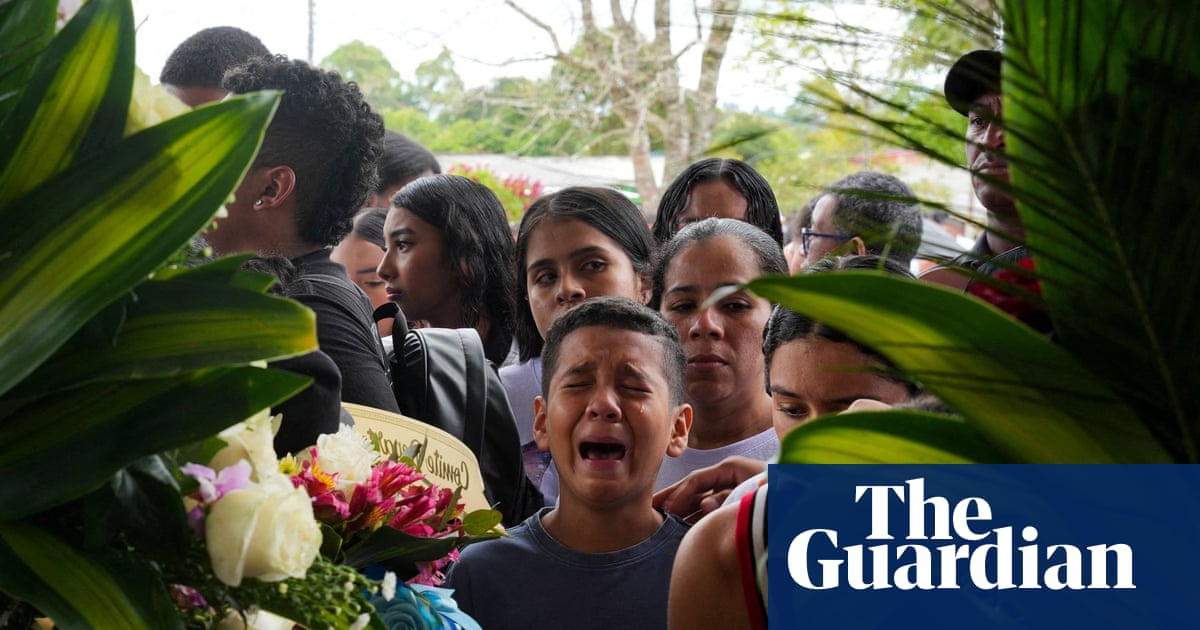
Twenty-one people were killed in a bombing on a major road at the weekend, one of the deadliest attacks on civilians in the country’s history. The attack was carried out by one of the most powerful Farc dissident groups, the Central Command, known by its Spanish initials ECM.
“It was not an isolated incident,” said María Victoria Llorente, the executive director of the Ideas for Peace Foundation, a thinktank. “It has to be seen in the broader context of the evolution of organised violence in Colombia.”
Petro’s peace promise has become a key issue before the election’s first round on 31 May. The constitution does not allow for re-election, and the president’s chosen candidate, the leftwing senator Iván Cepeda – widely seen as the architect of “total peace” – supports maintaining the programme. But the rightwing candidates Abelardo de la Espriella and Paloma Valencia, close behind in the polls, both promise to scrap the plan and return to all-out war as soon as they take office.
Llorente said: “It is clear that total peace has failed. When this government began, there were six departments of the country under dispute. Today there are between 13 and 14.”
The basic premise was to offer armed groups benefits such as reduced sentences, the chance to retain part of their wealth and the suspension of military operations against them in exchange for their dismantling, disarmament and a transition to legal economies.
Soon after taking office, Petro announced a ceasefire agreement with the country’s five largest armed groups. Many analysts noted that he did so without established protocols or monitoring mechanisms, which had been vital to the success of the original peace agreement with the Farc.
Shortly afterwards, the National Liberation Army (ELN) – now the country’s largest rebel group – denied having agreed to any truce. There were further unsuccessful attempts to reach agreements with the ELN and other groups, but most of the negotiations are now either frozen or abandoned.
Meanwhile, the armed factions have taken advantage of temporary ceasefires to continue expanding – a process already under way before Petro – and clashing among themselves for territorial control and illicit economies such as drug trafficking – Colombia is the world’s largest producer of cocaine – and mining.
At the start of 2025, fighting between the ELN and the Farc dissident group Frente 33 left more than 80 people dead and 60,000 displaced, the largest episode of forced displacement in Colombia’s history.
Despite having been a staunch critic of lethal military action at the start of his term, Petro authorised the resumption of artillery assaults and airstrikes, some of which have resulted in the deaths of several young people forcibly recruited by criminal groups.
This year is already the most violent since the 2016 peace agreement, and the election race has been marked by the first assassination of a prominent presidential hopeful in more than three decades. The rightwing senator Miguel Uribe Turbay was shot during a campaign event in June 2025 by the Farc dissident group Segunda Marquetalia and died several months later.
In February, the leftwing senator Aida Quilcué was briefly kidnapped while travelling through south-west Colombia, in the same department, Cauca, where the bomb exploded last weekend. For more than 20 years, she has campaigned for Indigenous rights, facing what she describes as countless “threats, attacks and forms of violence”. But she said the ambush marked a new level of danger – the first time she had been abducted and the closest she felt to being assassinated.
Men dressed in camouflage and with scarves covering their faces forced Quilcué and her bodyguards to kneel and pressed guns into their backs. News of the kidnapping quickly made headlines and authorities launched a search operation. Four hours later, the captives were released. In March, Quilcué was announced as the vice-presidential candidate on Cepeda’s ticket.
Francisco Daza, a coordinator of the Colombian Peace and Reconciliation Foundation, said: “The elections have so far been marred by a context of insecurity and violence.”
All the main presidential candidates have reported receiving threats. Daza said some illegal armed groups wanted to interfere in the electoral cycle. “They’re seeking to limit the degree to which people participate in the electoral process,” he said. “Murder and kidnapping serve as a warning.”
He said many citizens were now avoiding political rallies and campaign events. Large areas of the countryside have in effect become no-go zones for politicians, where campaigning without permission from armed groups can be extremely dangerous.
Llorente said there was a perception among some that the country had returned to its “worst moments” of violence, but she said this was not accurate. “The scale of violence is very different,” she said, noting that although numbers had risen, the current rate of about 26 homicides per 100,000 inhabitants remained far below the peak of about 80 per 100,000 in the early 1990s.
Llorente said the answer lay within Colombia. “We have a long track record of innovation in peace, security and transitional justice. We are not starting from scratch. The key lesson Colombia has learned is that all the tools available to the state – negotiation, the use of public force, criminal policy – must be used. But they need to be applied far more strategically than they have been in this government,” she said.
Catalina Beltrán, of Colombia Risk Analysis, said the next government, whether left or right, would face an extremely difficult challenge due to the fragmentation of the conflict, with groups spread across all regions of the country.
“Rather than a single solution, the situation needs to be approached calmly, avoiding overly ambitious decisions like those taken by this government,” she said. “I would say that strengthening a mixed strategy of negotiations and offensive actions could be the most appropriate approach.”
Source link
